Plans & PS&E
Any milestone from 30% to 100%, any discipline: roadway, drainage, structures, traffic, utilities, staging and more.

Put risk in its place.
CivilRisk IQ reviews plans, technical reports, environmental documents and Caltrans submittals with a team of 21 AI specialists. An accountable engineer or decision-maker then verifies what matters, so every finding is tied to its source and ready for a decision.
State highway and local projects · Typical review in 5–10 business days

Observation. D-7 removes the existing double 6 ft × 2 ft RCB culvert at Zeiders Road and builds a new one at the same crossing. No temporary flow route is shown for the interval in between.
Why it matters. Without a coordinated diversion, runoff could flood the work area or roadway and delay construction.
Next check. Compare staging and temporary drainage sheets with the existing flow path; confirm the excavation, diversion and reconnection sequence.
The difference
Traditional review often finds the hazards once you are already in them. CivilRisk IQ shows you where they are before you swing, so your team can choose the next move with confidence.
How it works
Agree on the plans, reports, studies and versions in scope. No project files are needed for the first conversation.
Discipline specialists read every sheet and page in parallel; a manager and a Red Team cull duplicates and weak claims.
A licensed engineer (design) or an authorized decision-maker (environmental) checks the evidence and decides what is released.
Executive summary, findings register, and PDF comment files for Bluebeam or Acrobat, plus optional portal access.
What we review
State highway projects or local capital improvements, early studies or final bid packages: the same specialist team and the same evidence-first method.
Any milestone from 30% to 100%, any discipline: roadway, drainage, structures, traffic, utilities, staging and more.
EIR, EIS, EA, IS/MND and every study inside them: biology, cultural, noise, air quality, water quality, hazardous materials, visual, traffic.
The reports behind the plans: geotechnical, soils and materials, foundation, structures, hydrology and drainage, traffic and utility reports.
PSRs, project reports, PA&ED and PS&E packages, design standard decision documents, storm water data reports: check them as part of a thorough QA process.
City and county work off the State Highway System: pavement rehab, curb and gutter, sidewalks and ADA ramps, storm drains, signals.
Special provisions, quantities, engineer's estimates and construction schedules, checked against the plans they support.
Don't see your document?
A real finding, step by step
How to read our examples: these are real candidates from CRIQ reviews of actual plan sets. Each shows its status; a candidate is a question for the design engineer, not a verified defect or a statement about current field conditions.
FL 1568.55 ft
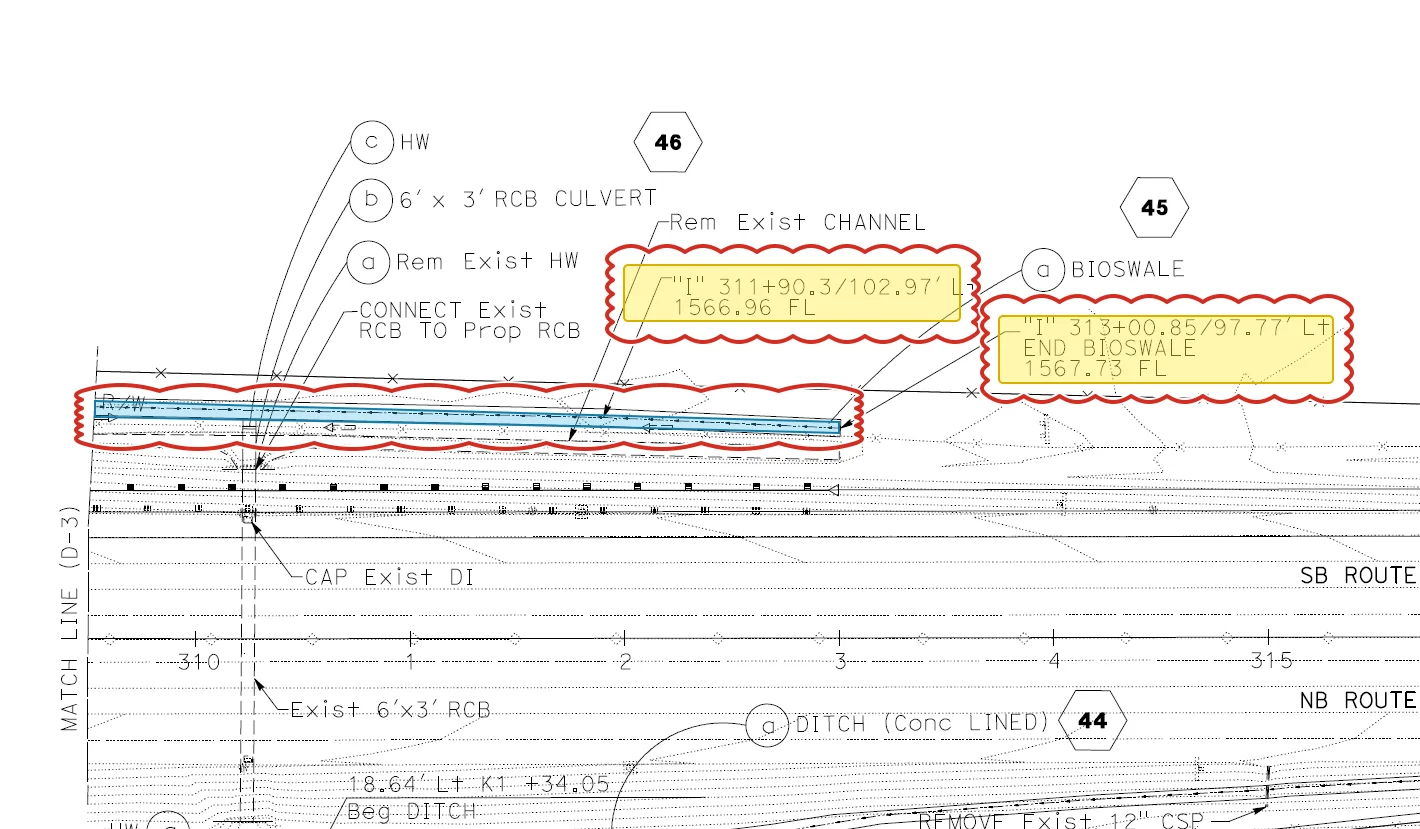
Bioswale 45 beginningFL 1566.96 ft
Intermediate gradeFL 1567.73 ft
End gradeI 311+90.3: FL 1566.96
I 313+00.85: FL 1567.73
End elevation is 0.77 ft above the intermediate low point.
No collection point was identified in the compared sheets. A rising grade alone does not establish a drainage defect.
Source-plan and drainage-design check neededConfirm stationing, flow-line elevations and the plotted grade on the source sheets and adjacent drainage details.
Is there an inlet, underdrain, cross-sheet connection or intentional reverse flow?
Engineer decides whether the concern holds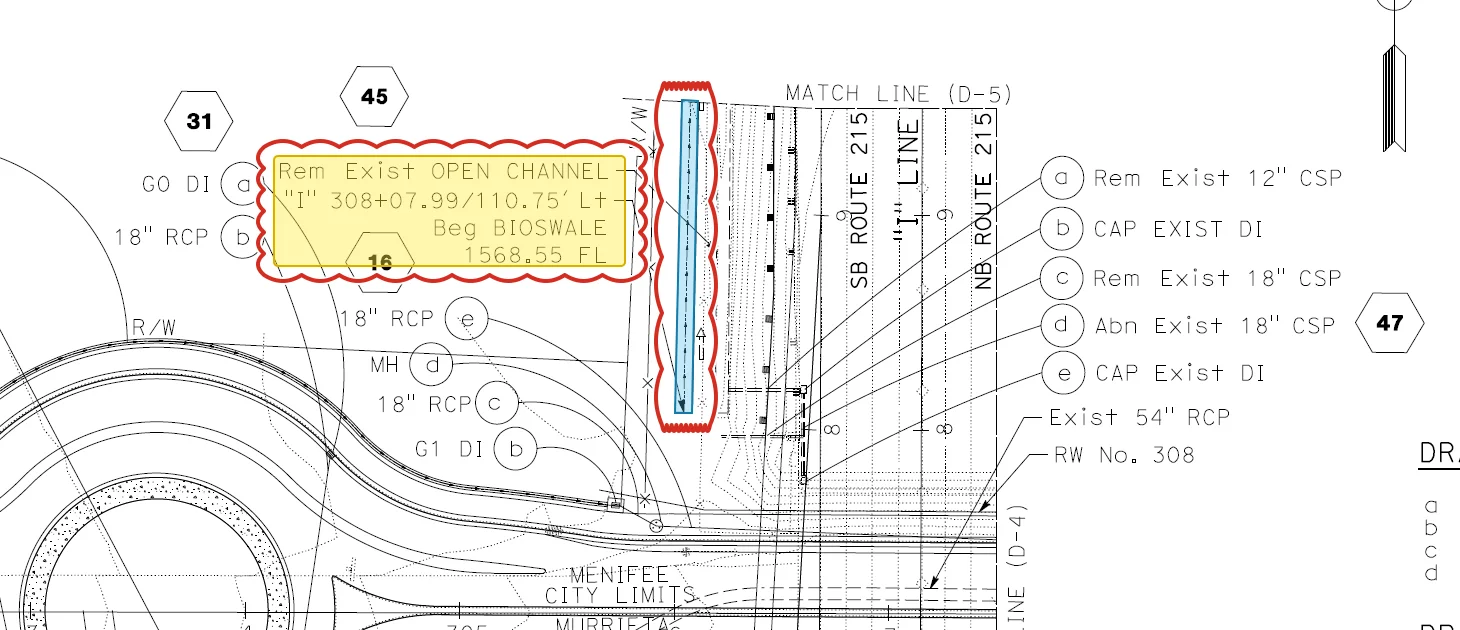
Sheet TH-02 ends a Type K railing run at Sta. 19+02.11; TH-01 begins one at 19+58.82 at nearly the same offset. If both apply to the same stage, the ~57 ft gap needs protection.
Candidate · traffic handlingAnchor rows with 20 ft unbonded lengths sit near existing piles and widening footings; 3-D drilling clearance isn't shown on the plans (source PDF p. 259).
Candidate · structuresMeet the review team
Each specialist is an AI reviewer built around one discipline, with its own checklist of what to look for. Tap a face to see its focus. The specialists prepare; a person with authority over the work decides what's released.

Every released finding is signed off by a person with authority over the work: a licensed engineer for plans and technical reports, or an authorized decision-maker for environmental documents.
How review sign-off works →Tap a specialist to see what it looks for.
Questions agencies and design teams ask
Almost any project record: plans at any PS&E milestone, on or off the State Highway System; environmental documents and every technical study inside them; the design technical reports behind the plans, such as geotechnical, materials, structures and drainage reports; Caltrans submittals; and specifications, estimates and schedules.
No. AI specialists find and organize candidate issues. A person with authority over the work decides what is released: a licensed engineer for plans and technical reports, or an authorized decision-maker for environmental documents.
A typical review takes 5 to 10 business days, depending on the size of the package and the agreed scope.
An executive summary, a findings register with sheet and page references, PDF comment files that open in Bluebeam or Adobe Acrobat, and optional portal access where your team can confirm, revise or dismiss each finding. See report formats.
Your documents are used for your review. Raw client documents never train models silently; only de-identified, engineer-adjudicated examples are used to improve CivilRisk IQ's review methods. Security & data.
California public agencies, including Caltrans districts, transportation commissions, cities and counties, and the AEC design firms that deliver their projects.
A conversation with the founder
Complimentary 20-minute consultation with founder Jason Bennecke. No project files needed. Meet Jason →
Authorized access, project-scoped storage, and no silent training on your documents. Security & data →
